Dart Frog Vivarium Setup: Size, Layers, Plants and Care
How to set up a bioactive vivarium for poison dart frogs: enclosure size, temperature and humidity, substrate layers, plants, cleanup crew, lighting, misting, feeding and why not to mix species.
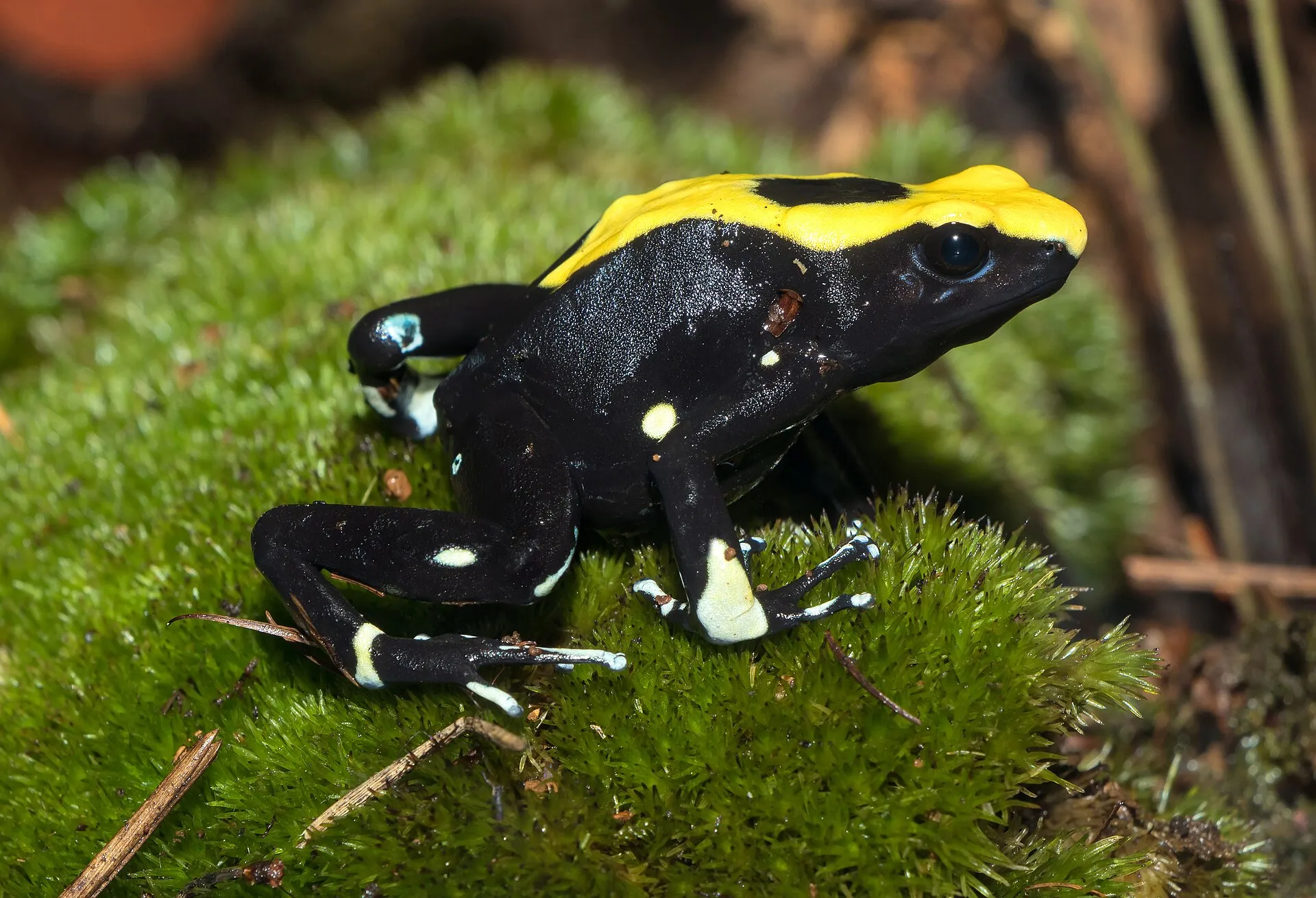 Photo: H. Zell, CC BY-SA 3.0
In this guide
Short answer: dart frogs need a humid, mostly closed glass vivarium kept at about 68–78 °F (20–26 °C) with 70–100% humidity. A common setup for 2–3 larger frogs (such as Dendrobates tinctorius or D. leucomelas) is an 18 × 18 × 24 in front-opening tank; tiny “thumbnail” species do well in a 12 × 12 × 18 in. Build it in layers: clay balls for drainage, a mesh barrier, a soil mix such as ABG, and a thick layer of leaf litter, then add tropical plants, springtails and isopods. Feed dusted fruit flies several times a week, and keep one species per tank.
Enclosure size
| Frogs | Common enclosure | Source |
|---|---|---|
| 1–3 D. tinctorius (azureus) | 20-gallon high or 18 × 18 × 18 in | Josh’s Frogs |
| 2–3 larger dart frogs, or a group of thumbnails | 18 × 18 × 24 in | Josh’s Frogs |
| A pair of thumbnails (Ranitomeya) | 12 × 12 × 18 in | Josh’s Frogs |
| General rule for adults | About 10 gallons per frog | Josh’s Frogs care sheets |
Not everyone uses that much space: the BGSU Herpetarium keeps a pair or trio of D. leucomelas in a 10-gallon tank. More room, though, makes it easier to keep conditions stable and gives frogs space to avoid each other. Front-opening glass terrariums make feeding and maintenance easier.
Dart frogs are kept in enclosures with little ventilation, to hold humidity. A glass lid or mostly glass top with a small screened vent is typical.
Temperature
Josh’s Frogs says dart frogs tolerate about 65–80 °F but prefer the low to mid 70s °F, and warns that temperatures over 85 °F are dangerous. Small Ranitomeya species are described as especially heat-sensitive. The BGSU Herpetarium keeps D. leucomelas warmer, at 75–84 °F by day.
In most homes, the room temperature is enough. The bigger risk is overheating in summer or under strong lights, so place a thermometer in the tank and keep it out of direct sun.
Humidity
Aim for 70–100% (Josh’s Frogs); the BGSU Herpetarium keeps about 95%. Josh’s Frogs notes that frogs can tolerate around 50% briefly if they can reach water, but low humidity without water can quickly be fatal. A mostly closed lid, regular misting and a damp substrate keep humidity up.
Lighting and UVB
Josh’s Frogs says dart frogs don’t need special lighting: the light is mainly for the plants. LED plant lights on a 12-hour timer are the usual choice.
UVB is debated. Some keepers add low-level UVB; others, such as DartFrog.pet, don’t recommend it, citing burn risk and the fact that glass lids block UVB. A field study found that wild Dendrobates tend to prefer spots with low UVB. Research on other amphibians suggests UVB can raise vitamin D levels, but there’s no equivalent study on dart frogs. If you use UVB, keep it low and provide plenty of shade.
Substrate layers
Josh’s Frogs’ care sheets use this layout, from the bottom up:
- Drainage layer: about 2 in of LECA (expanded clay balls)
- Barrier: mesh that keeps soil out of the drainage layer
- Substrate: about 2 in of ABG mix or a dart-frog bioactive substrate
- Moss: a thin layer of long-fiber sphagnum (optional)
- Leaf litter: a generous layer on top
The substrate must never become waterlogged; Josh’s Frogs notes a waterlogged one smells like rotten eggs. Drain the water that collects in the clay layer when needed. Read more in drainage layer in a bioactive terrarium and bioactive substrate mix. Our substrate calculator works out how much of each layer you need.
Josh’s Frogs suggests adding fresh leaf litter about every 6 months and replacing the substrate every 3–5 years.
Plants
Dart frog vivariums are usually heavily planted. Josh’s Frogs’ 18 × 18 × 24 kit includes:
- Bromeliads (Neoregelia), whose water-holding leaves frogs use
- Pothos, philodendron and Syngonium
- Ferns (Nephrolepis, rabbit’s foot fern)
- Selaginella, Begonia rex, Hypoestes and Monstera adansonii
- Java moss
See our best plants for a bioactive terrarium for more options.
Cleanup crew
Springtails and tropical isopods such as dwarf whites break down waste and mold, and they’re also extra food for the frogs. Josh’s Frogs includes dwarf white isopods in its kits. See how to culture springtails, dwarf white isopod care and mold in a bioactive terrarium.
Water and misting
- Mist enough to keep humidity in range; many keepers mist once or twice a day by hand or use an automatic misting system. There’s no single standard schedule.
- Josh’s Frogs’ kits include a tap water dechlorinator, while many keepers prefer RO or distilled water for misting because it leaves no spots on the glass and doesn’t clog misting nozzles.
- Keep any water dish shallow: the BGSU Herpetarium notes dart frogs are weak swimmers and can drown.
Feeding
- Fruit flies (Drosophila melanogaster) are the staple for nearly all dart frogs. Larger species also take D. hydei, pinhead crickets, springtails and isopods.
- Thumbnail species need prey smaller than about 1/8 in.
- Dust every feeding with a vitamin and mineral supplement. Josh’s Frogs feeds on Monday, Wednesday and Friday and rotates calcium with D3, a multivitamin and a vitamin A supplement. The BGSU Herpetarium feeds adults daily.
Are captive dart frogs poisonous?
Generally no. The Smithsonian’s National Zoo explains that wild dart frogs get their toxins from the ants, mites and other insects they eat. Captive-bred frogs eat fruit flies and crickets, which don’t contain those toxins, so they aren’t poisonous. They’re still delicate: Josh’s Frogs and the BGSU Herpetarium both advise handling them as little as possible, since oils and chemicals on human skin can harm them.
Don’t mix species
Josh’s Frogs strongly recommends against mixing species, or even different morphs of the same species:
- Different species and morphs can crossbreed, muddying captive bloodlines.
- Aggression increases as frogs mature.
- Shy or weaker frogs may be outcompeted for food.
- Mixing frogs from different sources risks disease.
Keep one species (and one morph) per vivarium.
Setting it up step by step
- Build the background and hardscape (wood, cork).
- Add the drainage layer, barrier and substrate.
- Plant, add leaf litter and moss.
- Add springtails and isopods.
- Run the lights and misting for a few weeks while plants root and the cleanup crew settles.
- Check temperature and humidity, then add the frogs.
New to bioactive setups? Start with how to set up a bioactive terrarium and what is a bioactive terrarium.
Frequently asked questions
What size tank do dart frogs need?
For 2–3 larger dart frogs, 18 × 18 × 24 in is a common choice; a pair of thumbnails can live in a 12 × 12 × 18 in. A general rule is about 10 gallons per adult frog.
Do dart frogs need UVB?
They don’t strictly need it, according to major breeders, but some keepers add low-level UVB. The evidence for dart frogs specifically is limited.
What temperature is too hot for dart frogs?
Above about 80 °F is risky for many species, and Josh’s Frogs calls temperatures over 85 °F dangerous.
Can I keep different dart frog species together?
It’s not recommended. Mixing can lead to crossbreeding, stress, competition for food and disease.
Sources
- Dendrobates tinctorius azureus (Josh's Frogs)
- Dart frog complete kit 18x18x24 (Josh's Frogs)
- Thumbnail dart frog complete kit 12x12x18 (Josh's Frogs)
- Ranitomeya ventrimaculata care sheet (Josh's Frogs)
- Phyllobates vittatus care sheet (Josh's Frogs)
- Before you buy (Josh's Frogs)
- Can I mix poison dart frogs? (Josh's Frogs)
- Yellow-and-black poison frog (BGSU Herpetarium)
- After insect detox, can once-poisonous frogs get their spice back? (Smithsonian's National Zoo)
- UVB lighting for dart frogs (DartFrog.pet)